NEXT STORY

Reasons for religion
RELATED STORIES


Video URL


NEXT STORY
Reasons for religion
RELATED STORIES


|
Views | Duration | |
|---|---|---|---|
| 61. Chefs against DNA! | 495 | 00:46 | |
| 62. Scientific advances as a result of the discovery of DNA | 1 | 424 | 01:56 |
| 63. Speed in scientific research is a relative thing | 391 | 00:43 | |
| 64. Would Darwin understand DNA? | 1 | 913 | 01:22 |
| 65. The idea of natural selection is formed | 466 | 01:09 | |
| 66. Natural selection: the essence of the idea | 478 | 01:42 | |
| 67. Explanation of species change before natural selection | 385 | 00:49 | |
| 68. Charles Darwin's career path | 545 | 01:25 | |
| 69. Adam and Eve: myth-busting | 568 | 00:39 | |
| 70. Thoughts on religion | 2 | 1128 | 02:07 |


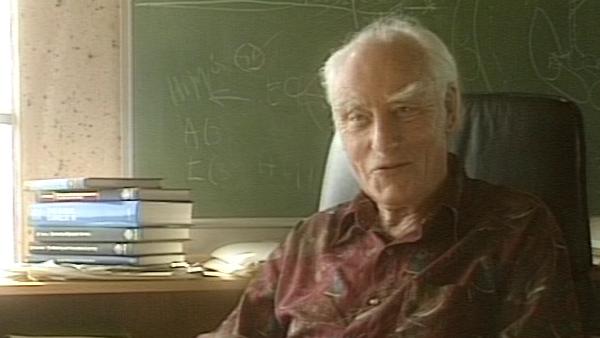
Now, I find it very difficult to take all this religious belief seriously because they almost all, leaving aside all the modern Californian ones and New Age stuff and all that kind of thing, they almost all originated at a time when our picture of the universe was totally different from what it is now. I mean, the universe in those days was… the Earth was the centre of the universe. We didn’t even know the whole surface of the Earth, but we knew a certain amount of it. That was man’s home. Man was clearly special, and therefore it was only reasonable he should have been put there for some purpose in this special little place and so on, and that he hadn’t been there for terribly long, never mind exactly how long – 5000 years, 10,000 years, something like that. And the Earth was not terribly much older than man. That was the… the picture, and it was a very reasonable picture to have at that particular time. And most religious beliefs are really done in that context. I say most, I mean, certainly the Christian ones and the ones that are associated with them, Judaism and… and Muslim beliefs, and so on. Well, now that’s totally been changed by science. Almost everything I’ve said just now is… we know now to be wrong and that we’re an insignificant planet in a rather minor star in one galaxy of God knows how many, and so on, and it seems rather vague that… that, you know, that God should have sent His Son just to this particular place, and so on. There are always jokes about, well does he have to go to all the other places in the universe where there’s life, and can he travel faster than the speed of light, and a few jokes of that kind, you know. But the point is it makes them all seem absurd. And as for the doctrine of the Trinity, I mean that’s bizarre when you look at it. I mean, how could anybody have thought out such… such an extraordinary doctrine? And yet you have a college named Trinity. I shall know that Cambridge has come into the modern world when they change the name of Trinity College, when they start calling it Newton College or something like that. Otherwise, they’re just living in the past. And most of them are living in the past, even though the name is only a minor symbolic thing.
The late Francis Crick, one of Britain's most famous scientists, won the Nobel Prize in Physiology or Medicine in 1962. He is best known for his discovery, jointly with James Watson and Maurice Wilkins, of the double helix structure of DNA, though he also made important contributions in understanding the genetic code and was exploring the basis of consciousness in the years leading up to his death in 2004.
Title: Thoughts on religion
Listeners: Christopher Sykes
Christopher Sykes is an independent documentary producer who has made a number of films about science and scientists for BBC TV, Channel Four, and PBS.
Tags: New Age, California, Earth, Christianity, Judaism, Muslim, Cambridge University, Trinity College
Duration: 2 minutes, 7 seconds
Date story recorded: 1993
Date story went live: 08 January 2010