NEXT STORY

Learning about theory
RELATED STORIES


Video URL


NEXT STORY
Learning about theory
RELATED STORIES


|
Views | Duration | |
|---|---|---|---|
| 31. Trying to make a reliable computer out of unreliable parts | 1 | 1513 | 03:16 |
| 32. Doodling during seminars at the Control Systems Laboratory | 1391 | 03:49 | |
| 33. Einstein | 1 | 4551 | 04:58 |
| 34. Oppenheimer | 2944 | 00:54 | |
| 35. The atmosphere at Princeton. Getting a job in Chicago | 1871 | 03:03 | |
| 36. Theoretical physics discussion group at Chicago | 1779 | 01:22 | |
| 37. Fermi | 2978 | 04:16 | |
| 38. Work at Chicago. Pseudo-scalar meson theory | 1440 | 03:56 | |
| 39. The atmosphere at Chicago | 1461 | 01:09 | |
| 40. Discussions with Enrico Fermi; resonance and symmetry | 2232 | 01:55 |


We discussed a lot with Enrico; the pion nucleon scattering, his analysis of it in terms of phase shifts, the presence, or absence of a resonance. He didn't like the resonance; in fact I don't think till his dying day he believed in a resonance. He favored a phase shift solution in which the phase shift didn't go through ninety degrees. And it took one of his students talking with Hans Bethe or a student of Hans Bethe, to discover that there was another phase shift solution that described the experiments equally well and where…in which the phase shift in the 3-3 state, the 3 halves 3 halves state actually did go through ninety degrees and produce a resonance. But of course that resonance had been expected for many, many, many years. In strong coupling it had been predicted by Pauli and Dancoff back in 1942, and then Keith Brueckner had made himself famous by doing some intermediate coupling calculations in the non-relativistic version of the pseudo-scalar meson theory, and showing that you would get a 3-3 resonance there. So we had a lot of practical discussions of that kind that were very educational and of course isotopic spin conservation was being confirmed further, if it needed further conservation… further, yes, further, sorry, if it needed further demonstration, in Fermi's… the experiments that Fermi and others were doing on the pion nucleon scattering. And we devoted a good deal of time to discussing symmetries and as I mentioned a little while ago, that was one way in which I felt it was possible to make progress, important progress on understanding what was going on without attempting something too ambitious–namely writing down the ultimate theory. Symmetry was, exploring symmetry was, one way to do that.
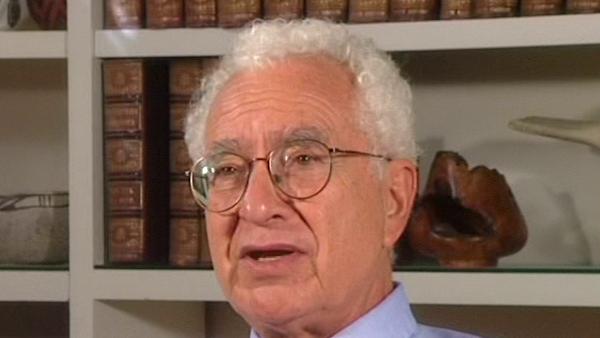
New York-born physicist Murray Gell-Mann (1929-2019) was known for his creation of the eightfold way, an ordering system for subatomic particles, comparable to the periodic table. His discovery of the omega-minus particle filled a gap in the system, brought the theory wide acceptance and led to Gell-Mann's winning the Nobel Prize in Physics in 1969.
Title: Discussions with Enrico Fermi; resonance and symmetry
Listeners: Geoffrey West
Geoffrey West is a Staff Member, Fellow, and Program Manager for High Energy Physics at Los Alamos National Laboratory. He is also a member of The Santa Fe Institute. He is a native of England and was educated at Cambridge University (B.A. 1961). He received his Ph.D. from Stanford University in 1966 followed by post-doctoral appointments at Cornell and Harvard Universities. He returned to Stanford as a faculty member in 1970. He left to build and lead the Theoretical High Energy Physics Group at Los Alamos. He has numerous scientific publications including the editing of three books. His primary interest has been in fundamental questions in Physics, especially those concerning the elementary particles and their interactions. His long-term fascination in general scaling phenomena grew out of his work on scaling in quantum chromodynamics and the unification of all forces of nature. In 1996 this evolved into the highly productive collaboration with James Brown and Brian Enquist on the origin of allometric scaling laws in biology and the development of realistic quantitative models that analyse the influence of size on the structural and functional design of organisms.
Tags: Enrico Fermi, Hans Bethe, Wolfgang Pauli, Sidney Dancoff, Keith Brueckner
Duration: 1 minute, 56 seconds
Date story recorded: October 1997
Date story went live: 24 January 2008