NEXT STORY

Mathematics is a discipline in its own
RELATED STORIES


Video URL


NEXT STORY
Mathematics is a discipline in its own
RELATED STORIES


|
Views | Duration | |
|---|---|---|---|
| 41. Publishing papers in Nature | 1437 | 00:49 | |
| 42. Reactions to the papers we published | 1361 | 00:58 | |
| 43. The beauty of the double helix model | 1757 | 00:30 | |
| 44. Life Story - a dramatisation of our work on DNA | 1214 | 01:23 | |
| 45. Gradual acceptance of the structure of DNA | 983 | 01:09 | |
| 46. Elegance and beauty in scientific theories | 1029 | 01:50 | |
| 47. Mathematics is a discipline in its own | 1385 | 01:17 | |
| 48. A physicist no longer | 1 | 1163 | 00:25 |
| 49. Looking at the world in a different way | 1038 | 00:34 | |
| 50. Interest in the brain generates many questionable theories | 697 | 02:00 |


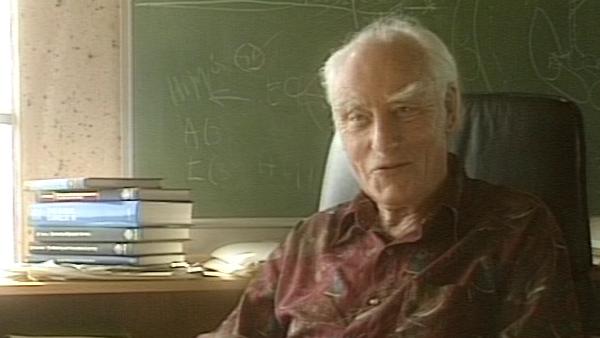
Some… some scientists have put a lot of emphasis on beauty and elegance being important for a theory. They say a theory is right if it has those qualities. That is probably true in very basic problems in physics. It’s less true in most biological problems because they… biological systems are the result of evolution, and they produce very complicated things. Now, the reason that DNA looks… looks so beautiful and simple is that it goes right back to near the origins of life, where things had to be simple. But if you actually look at the actual process of DNA replication, it isn’t at all the way that it… we used to describe as the sort of conceptual way. All sorts of funny things happen. You start off by making a bit of RNA, then you put the DNA on the end, then you cut the RNA out, then you fill it in. All sorts of little things. You have to have… you have to have proteins which will unwind the helix and link it and then join it together again. You get an enormously baroque, complicated apparatus which actually does the job, which you could hardly say was simple and beautiful. It’s doing a lot of subsidiary things. It’s the basic idea which is simple and beautiful. And there will be things like that in biology, but often it means looking into the way these complications that… have been produced by evolution and seeing how all those complications fit together. So, I think there’s nothing corresponding to evolution by natural selection in chemistry and physics as such; it only occurs in biology, and this gives biology a particular different flavour. And it’s this flavour which is very difficult for mathematicians and… and physicists coming into the subject to appreciate because their subjects have a different flavour.
The late Francis Crick, one of Britain's most famous scientists, won the Nobel Prize in Physiology or Medicine in 1962. He is best known for his discovery, jointly with James Watson and Maurice Wilkins, of the double helix structure of DNA, though he also made important contributions in understanding the genetic code and was exploring the basis of consciousness in the years leading up to his death in 2004.
Title: Elegance and beauty in scientific theories
Listeners: Christopher Sykes
Christopher Sykes is an independent documentary producer who has made a number of films about science and scientists for BBC TV, Channel Four, and PBS.
Tags: scientist, scientific theory, physics, evolution, DNA, origin of life, Ribonucleic acid, RNA, double helix, biology, chemistry
Duration: 1 minute, 50 seconds
Date story recorded: 1993
Date story went live: 24 January 2008